


 PLATFORM UPDATE:


Electrostatic screening in nanotubes: a tubular response function framework
 a
and
Nikita
Kavokine
*a
a
and
Nikita
Kavokine
*a
Abstract
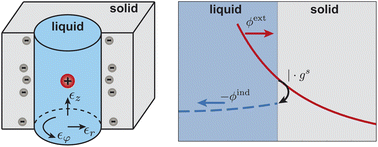
The structure and transport of electrolytes in nanoscale channels are known to be affected by the electronic properties of the confining walls. This influence is particularly pronounced in quasi-one-dimensional nanotubes, where the high surface-to-volume ratio makes the wall the dominant source of electrostatic screening. For instance, ideal metallic tubes suppress long-range Coulomb interactions between ions exponentially. Yet, there exists no generic framework for evaluating electrostatic interactions in tubular confinement. Here, we introduce tubular response functions – a generalisation of surface response functions that captures how nanotubes with arbitrary electronic properties screen Coulomb interactions. Using this framework, we evaluate the interaction potential of ions confined in a metallic carbon nanotube, treating its long-range electronic properties exactly within a Luttinger liquid model. We demonstrate that the screening characteristic of metallic armchair carbon nanotubes is almost identical to that of an ideal metal, regardless of electron density. We trace the origin of such strong screening to the quantum confinement of electrons around the tube circumference and to the suppression of Friedel oscillations. Our framework opens the way for quantitative descriptions of ionic correlations and charge storage in nanotube-based electrodes, and can be further extended to address confined ion dynamics.
- This article is part of the themed collection: Molecular and Ion Flows through Angstrom-scale Channels Faraday Discussion
 Please wait while we load your content...


