


 PLATFORM UPDATE:


Ionic memory or electrode artefacts? A systematic assessment of nanofluidic memristors
 ac
Kalluvadi Veetil
Saurav,
bc
Solleti
Goutham,
ac
Anshu
Sharma,
ad
Ashok
Keerthi
bc
and
Boya
Radha
*ac
ac
Kalluvadi Veetil
Saurav,
bc
Solleti
Goutham,
ac
Anshu
Sharma,
ad
Ashok
Keerthi
bc
and
Boya
Radha
*ac
Abstract
Nanofluidic memristors have recently emerged as a promising alternative to mimic brain-like synaptic functions for neuromorphic applications. Here, we observed that when fluidic devices such as nanoporous membranes are measured with Ag/AgCl electrodes, pinched hysteresis in current–voltage (I–V) loops can be generated even when there is no intrinsic ionic memory behaviour. The nanoporous membranes like nitrocellulose/mixed-cellulose ester (MCE) and polyvinylidene fluoride (PVDF) show memory signatures including pinched I–V loops, nonlinearity, and frequency dependent variation in loop area with Ag/AgCl electrodes, whereas the I–V response became purely capacitive when platinum or glassy carbon electrodes were used in two/three-electrode configurations. The same hysteresis could also be reproduced in a bulk electrolyte without any membrane, confirming its origin due to the Ag ⇌ AgCl redox reaction and salt deposition. In contrast, nanochannel devices made by van der Waals assembly of 2D materials retained their characteristic memory loops regardless of the chosen electrode material. These results show that electrode effect can mimic fundamental memristive signatures and therefore highlight the importance of electrode control to develop reliable, energy efficient fluidic computing architectures.
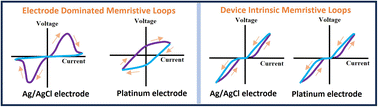
- This article is part of the themed collection: Molecular and Ion Flows through Angstrom-scale Channels Faraday Discussion
 Please wait while we load your content...


