


 PLATFORM UPDATE:


Critical assessment of theoretical modelling of single-atom catalysts

Abstract
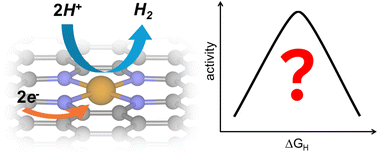
The rational design of catalysts from first principles remains a central but still elusive goal of modern quantum chemistry. Although advances in computing power and electronic-structure methods have made predictive modelling increasingly feasible, accurately forecasting catalytic activity from theory alone remains challenging. Single-atom catalysts (SACs), with their more defined active sites, offer in principle simplified models compared with conventional heterogeneous systems, yet in many cases discrepancies between theoretical predictions and experimental results persist. Using the hydrogen evolution reaction (HER) as a prototypical case, this study analyses the limitations of current computational approaches, particularly those based on the computational hydrogen electrode (CHE), and the problems arising when theoretical predictions are compared with experimental evidence. Factors contributing to these discrepancies include the sensitivity of reaction thermodynamics to the local atomic environment, the often-unknown experimental structure of SACs, and the neglect of reaction intermediates that form on SACs and not on extended metal surfaces. Additional challenges arise from solvent effects, catalyst evolution under operating conditions, and the potential instability of theoretically designed materials under realistic electrochemical environments. Furthermore, intrinsic approximations in density functional theory introduce uncertainties that hinder quantitative accuracy. Overall, the CHE model, while valuable for identifying general trends, does not include many critical terms that contribute to the activity of untested catalysts. Progress toward the true rational design of catalysts will require integrating these chemical complexities and uncertainties, potentially through artificial intelligence and data-driven methods, to develop more robust descriptors and predictive frameworks.
- This article is part of the themed collection: Bridging the Gap from Surface Science to Heterogeneous Catalysis Faraday Discussion
 Please wait while we load your content...


