


 PLATFORM UPDATE:


Biorefining of crab shells for protein recovery using natural deep eutectic solvents: physicochemical and functional characterization of crab shell proteins
 a
and
Idaresit
Ekaette
*ab
a
and
Idaresit
Ekaette
*ab
Abstract
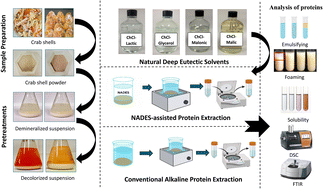
Seafood consumption has steadily increased in recent years. Among crustaceans, crabs have made a significant contribution to the food waste, due to 60% of shell which is inedible. Although crustacean shell valorization has gained significant attention, conventional approaches do not fully exploit the high-value potential of crab shells. In this study, cooked and uncooked snow crab shells were used as a feedstock for protein extraction. The protein content of cooked versus uncooked (fresh) crab shells ranged from 18.87–17.26% (dry weight). The proteins were extracted by using conventional alkaline extraction and Natural Deep Eutectic Solvents (NADES) assisted extraction. The highest extracted yield was achieved with combined NADES of Choline chloride (ChCl) and Malic acid, at a 1 : 30 solid to liquid ratio at 50 °C. Combined NADES of ChCl with Malonic acid and Lactic acid also demonstrated good performance, while the combined NADES of ChCl and glycerol was least effective. Across both cooked and uncooked shells, the highest protein concentration was achieved with ChCl-malonic acid, solid : liquid 1 : 30, and at 50 °C. Functional properties characterization results demonstrated that ChCl-malonic acid exhibited the most balanced performance, with high solubility, superior FC/FS (up to 125%), strong ESI at acidic pH, and enhanced thermal stability. Cooked proteins were more soluble than uncooked proteins across all NADES. However, cooked proteins were less heat-stable than uncooked proteins. Identifying the functional potential of these protein isolates highlights their suitability for food applications, transforming crab shell waste into a valuable zero-waste resource with utilization potential across all its components.
 Please wait while we load your content...


