


 PLATFORM UPDATE:


A review of fungal chitosan for bioactive and biodegradable food packaging: green extraction, properties, structure–function relationships, and applications
 abc
Tharindra
Weerakoon,
d
Arianna
Dick,
b
Benu
Adhikari,
b
Chathuri M.
Senanayake
*a
abc
Tharindra
Weerakoon,
d
Arianna
Dick,
b
Benu
Adhikari,
b
Chathuri M.
Senanayake
*a
Abstract
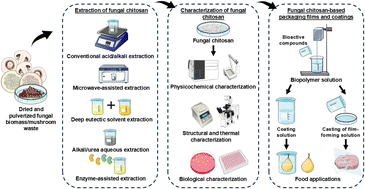
The increasing global demand for sustainable food packaging has encouraged extensive research into biodegradable and functional biopolymers. Among these, chitosan, produced through the deacetylation of chitin, demonstrates outstanding antimicrobial, antioxidant, film-forming, and biocompatible properties that make it suitable for food preservation. Although crustacean shells remain the predominant industrial source, fungal-derived chitosan has emerged as a promising alternative due to its non-allergenic characteristics, consistent yield, and environmentally friendly extraction methods. This review provides a comprehensive overview of the chemistry, extraction techniques, and physicochemical characteristics of fungal chitosan, emphasizing its potential in bioactive and biodegradable food packaging. Both conventional acid-alkali extraction and novel green approaches, including microwave-assisted, enzyme-assisted, and deep eutectic solvent methods, are examined with respect to efficiency, purity, and environmental sustainability. Furthermore, the physicochemical, structural, thermal, biochemical, and biological properties of fungal chitosan are analyzed in relation to their functional relationships for packaging performance. The review also discusses the mechanical, barrier, thermal, optical, antimicrobial, antioxidant, and biodegradability properties of edible films and coatings formulated with fungal chitosan and their effectiveness in food preservation. Finally, potential challenges and future perspectives for advancing fungal chitosan-based packaging systems in the food industry are highlighted. In particular, this review underscores the significance of fungal chitosan as a sustainable and multifunctional biopolymer for next-generation food packaging solutions.
 Please wait while we load your content...


