


 PLATFORM UPDATE:


Exopolysaccharides and conjugated linoleic acids produced by selected lactic acid bacteria: physicochemical attributes, antimicrobial activity, and techno-functional properties of exopolysaccharides

Abstract
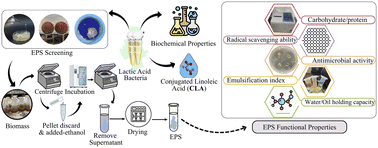
Lactic acid bacteria (LAB) exopolysaccharides (EPS) are high-value biopolymers that have predominant applications in the food sector owing to their thickening, gelling, stabilizing, texturizing, emulsifying, and flocculating properties, while conjugated linoleic acids (CLAs) have potential health benefits for humans. This study aims to screen and isolate bacterial strains based on their EPS and CLA production as well as to characterize the carbohydrate and protein content, water and oil holding capacity, emulsification, antimicrobial activity, and hydroxyl radical scavenging activity of EPS. In this study, 50 out of 300 bacterial strains stocked in the laboratory were screened using agar media, and 18 strains were selected based on their EPS production. Afterward, the CLA production and EPS techno-functional properties of the 10 bacterial strains with the highest EPS-producing capacity (Lactobacillus acidophilus, Enterococcus faecium, Lactiplantibacillus plantarum, Streptococcus thermophilus, Lactococcus lactis, Lacticaseibacillus casei, Lactobacillus delbrueckii subsp. bulgaricus, Pediococcus pentosaceus, Lactobacillus paraplantarum, and Lactobacillus delbrueckii subspp. lactis) were evaluated. The EPS production varied significantly, from 39.02 mg L−1 in Lactococcus raffinolactis B425 to 2210.18 mg L−1 in Lactobacillus acidophilus LDMB01. For CLA production, Lactobacillus del. spp. bulgaricus M240 exhibited the highest yield (30.60 µg mL−1). In terms of techno-functional properties, Enterococcus faecium D325 had the highest carbohydrate content (749.89 µg mL−1) while Lactobacillus delbrueckii subsp. bulgaricus M240 exhibited the highest protein content (194.87 µg mL−1). Lacticaseibacillus casei LDMB03 demonstrated the highest water-holding (204.28%) and oil-holding (309.59%) capacity. The 10% EPS exhibited the highest antimicrobial activity against the tested pathogenic bacteria, even at relatively low concentrations. Pediococcus pentosaceus B225 had the strongest emulsification index while the highest hydroxyl radical scavenging activity (94.40%) was recorded for Lactococcus lactis LDMB10. These findings highlight the diverse functional properties of LAB-derived EPS, underscoring their potential for the development of functional foods, pharmaceuticals, and cosmetic products.
 Please wait while we load your content...


