


 PLATFORM UPDATE:


Microwave-assisted extraction as a fast and sustainable approach for the recovery of caffeine and chlorogenic acids from coffee silverskin: evaluation of operating conditions and comparison with conventional extraction
 †*a
Marlene
Machado,
†a
João A. V.
Prior,
*a
M. Beatriz P. P.
Oliveira
a
and
Rita C.
Alves
*a
†*a
Marlene
Machado,
†a
João A. V.
Prior,
*a
M. Beatriz P. P.
Oliveira
a
and
Rita C.
Alves
*a
Abstract
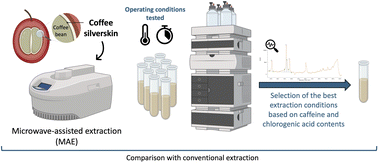
The recovery of bioactive compounds in a fast, sustainable, and efficient way from food matrices, particularly from food by-products, is increasingly a key priority for industries. This study aimed to evaluate microwave-assisted extraction (MAE) conditions for the recovery of caffeine and chlorogenic acids (CGAs) from coffee silverskin, the main by-product of coffee roasting industries, and to compare its performance with that of a conventional extraction under selected conditions. Different temperatures and times were tested in MAE to maximize caffeine and CGA yields, which were analyzed by reverse-phase high-performance liquid chromatography-photodiode array detection (RP-HPLC-DAD). MAE evaluation showed that caffeine extraction was stable across temperatures and times, while CGA contents were higher at 80 °C combined with 5 minutes of extraction, with 5-CQA being the most abundant CGA. Above this temperature and for longer extraction times (beyond 10 minutes), isomerization of 5-CQA to 3-CQA and 4-CQA and degradation of CGA were noticed. Comparing the best conventional extract with MAE extracts, MAE provided higher CGA (but not caffeine) yields in a significantly shorter time using only water as a solvent, contrasting with hydroethanolic solvent and 120 minutes of extraction used in conventional extraction. Additionally, this study also found that the grinding degree influenced CGA extraction, with finer grinding improving recovery. Therefore, these results show that MAE has great potential to be used as a sustainable, cost- and time-effective alternative for the recovery of bioactive compounds from coffee silverskin, thus promoting its valorization and enhancing the environmental performance of coffee roasting industries.
 Please wait while we load your content...


