Portable Raman spectroscopy combined with machine learning for highly sensitive and rapid detection of food pollutants with flexible Ag@TiO2@polyester SERS substrates

Abstract

Surface-enhanced Raman spectroscopy (SERS) holds promise as a sensing technique, yet it faces challenges in precisely identifying trace contaminants in food due to limitations in substrate sensitivity and high surface purity. This study presents an SERS substrate enabling the precise and ultrasensitive identification of multiple pollutants combined with machine learning algorithms and a portable Raman spectrometer. The substrate achieves an enhancement factor of up to 1.02 × 10⁸. This enhancement is attributed to the synergistic effects of Ag nanoparticles (NPs) and a porous TiO2 layer on the substrate. Leveraging its high surface purity and exceptional sensitivity, the substrate successfully distinguishes between multiple hazardous pollutants with similar geometries and ultralow concentrations in aquatic products, aided by principal component analysis (PCA). Consequently, this effective SERS substrate, combined with artificial intelligence, advances the application of SERS technology in accurately identifying trace contaminants in the field of food safety.
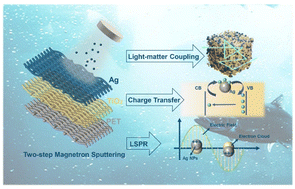
Graphical abstract: Portable Raman spectroscopy combined with machine learning for highly sensitive and rapid detection of food pollutants with flexible Ag@TiO2@polyester SERS substrates

Supplementary files

Article information

Article type
Paper
Submitted
31 Oct 2025
Accepted
05 Dec 2025
First published
08 Dec 2025
This article is Open Access
Creative Commons BY-NC license

Sustainable Food Technol., 2026, Advance Article

Portable Raman spectroscopy combined with machine learning for highly sensitive and rapid detection of food pollutants with flexible Ag@TiO2@polyester SERS substrates

Y. Huang, D. Lu, S. Zhang, S. Jiang, Y. Zhou and J. Xu, Sustainable Food Technol., 2026, Advance Article , DOI: 10.1039/D5FB00802F

This article is licensed under a Creative Commons Attribution-NonCommercial 3.0 Unported Licence. You can use material from this article in other publications, without requesting further permission from the RSC, provided that the correct acknowledgement is given and it is not used for commercial purposes.

To request permission to reproduce material from this article in a commercial publication, please go to the Copyright Clearance Center request page.

If you are an author contributing to an RSC publication, you do not need to request permission provided correct acknowledgement is given.

If you are the author of this article, you do not need to request permission to reproduce figures and diagrams provided correct acknowledgement is given. If you want to reproduce the whole article in a third-party commercial publication (excluding your thesis/dissertation for which permission is not required) please go to the Copyright Clearance Center request page.

Read more about how to correctly acknowledge RSC content.

Social activity

Spotlight

Advertisements