


 PLATFORM UPDATE:


Pulsed electric field pretreatment reveals matrix-dependent mass transfer mechanisms in phenolic recovery from pomegranate peel

Abstract
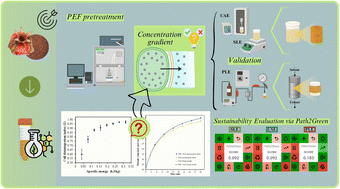
Understanding the mechanisms that govern mass transfer is crucial for designing efficient and sustainable extraction processes for plant-derived bioactive compounds. Pulsed electric fields (PEF) pretreatment is widely recognized for enhancing extraction by inducing electroporation and disrupting cell structures. However, its effectiveness is highly dependent on matrix characteristics and is often overestimated in systems with high solute availability. In this study, PEF was applied as a pretreatment step prior to pressurized liquid extraction (PLE) to improve mass transfer during phenolic recovery from fresh pomegranate peel, a matrix intrinsically rich in phenolic compounds. Despite achieving significant cell permeabilization (Z > 0.9), PEF resulted in only marginal improvements in extraction yield, suggesting that diffusion driven by the chemical potential difference between the matrix and the solvent was the dominant mechanism. To clarify the underlying mass transfer phenomena, stirred liquid extraction (SLE) and ultrasound-assisted extraction (UAE) were performed as comparative strategies, allowing the relative contributions of solvent accessibility, diffusional driving force, and structural disruption to be systematically evaluated. Kinetic modeling using Peleg's equation and cumulative solvent-to-feed (S/F) analysis revealed that more than 80% of phenolics were recovered within the first 5 min of batch extraction, and that increasing solvent availability minimized acoustic cavitation-related effects. These findings demonstrate that PEF effectiveness is strongly matrix-dependent and provide critical mechanistic insights for the rational design of mass transfer–intensifying strategies, enabling more efficient and scalable phenolic recovery from agro-industrial by-products.
 Please wait while we load your content...


