


 PLATFORM UPDATE:


Ho Wood (Cinnamomum camphora) essential oil nanoemulsion as a natural alternative combined with UV-C LED for Staphylococcus aureus reduction in plant-based burger analogues
 *ab
Carlos Adam
Conte-Junior
abcde
*ab
Carlos Adam
Conte-Junior
abcde
Abstract
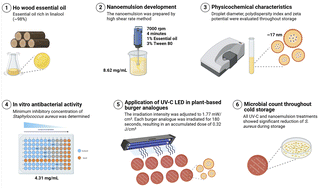
The combination of emerging preservation technologies has been the subject of frequent study in recent years. This study evaluated the antimicrobial efficacy of a Ho Wood essential oil nanoemulsion (nHWEO) combined with UV-C LED irradiation for the preservation of plant-based burger analogues. The nanoemulsion prepared with a high-shear homogenizer had an initial droplet diameter of 17.16 ± 6.23 nm. Taken together, the results demonstrate that the small initial droplet diameter favored the system's kinetic stability over 38 days at 4 °C (48.84 nm) and 25 °C (98.74 nm), indicating that the system retained typical nanoemulsion characteristics throughout the evaluation period. The nanoemulsion exhibited greater antimicrobial activity against Staphylococcus aureus, with a minimum inhibitory concentration (MIC) of 4.31 mg mL−1, which is lower than that of the free oil (MIC > 4.31 mg mL−1). In the antibacterial activity assay on plant-based burger analogues, treatment with UV-C LED alone (0.32 J cm−2) resulted in the most significant bacterial reduction (0.88 log CFU g−1) after 6 days of storage, surpassing treatments with nHWEO alone and the combination with UV-C LED (0.63 and 0.68 log CFU g−1, respectively). These results highlight the superior antibacterial effects of UV-C LED and the impact of nHWEO nanoemulsions when combined with non-thermal technologies. Although the combination of treatments resulted in a subadditive effect, this behavior may reflect complex interactions between the physicochemical mechanisms of action. Thus, the study highlights not only the individual potential of these approaches but also the relevance of exploring combined strategies to develop more sustainable and adaptable solutions for preserving plant-based foods.
 Please wait while we load your content...


