


 PLATFORM UPDATE:


Role of phosphorylated corn starch in the texturization of high moisture meat analogues
 *bc
*bc
Abstract
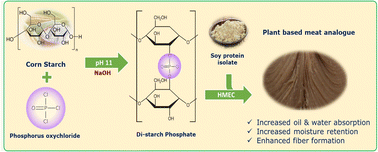
Native corn starch (NCS) is a versatile ingredient in the formulation of a wide range of extruded food products. Its low heat endurance, intolerance to low temperatures, anti-shearing properties and tendency to retrograde limit its application in production of high moisture extrudates, despite its good texturization potential. Cross-linking of corn starch by phosphorylation can improve thermal stability during high moisture extrusion. To the best of our knowledge this is the first study reporting the application of phosphorylated corn starch in high moisture extrudates. The corn starch was phosphorylated using phosphorus oxychloride (POCl3) with concentrations of 0.01%, 0.04%, 0.1%, and 0.3%. The phosphate content of the PCS was found to be 0.16% and 0.31% for 0.01% and 0.04% POCl3, respectively. Corn starch phosphorylated using 0.3% POCl3 exhibited 34.82% higher Water Solubility Index (WSI) and 363.44% lower swelling power than native corn starch (NCS). Phosphorylated corn starches exhibited A-type crystallinity similar to native corn starch (cI 52.8%; Tp 88 °C) but with decreased crystallinity indices (cI: 41.52–47.06%) and low gelatinization temperature (Tp: 68–80 °C). PCS was utilised in high moisture extrusion of meat analogues (HMMAs). High moisture meat analogues containing PCS resulted in a highly fibrous anisotropic structure compared to extrudates containing the native corn starch. Extrudates containing soy protein isolate (SPI) and phosphorylated corn starch (0.04% POCl3) showcased a marginal increase (0.04%) in expansion ratio (ER), a 0.09% increase in bulk density, a 0.02% increase in oil absorption index (OAI) and a marginal decrease of 0.27% in degree of starch gelatinization (DSG), and a significant increase of 21.5% in water absorption index (WAI) when compared with the extrudate (SPI–NCS) prepared using SPI and NCS. Findings from this study indicate that phosphorylated starch is a potential and appropriate alternative to native starches for creating HMMAs with an enhanced fibrous anisotropic structure and improved techno-functional properties.
 Please wait while we load your content...


