


 PLATFORM UPDATE:


Biodegradable polymer films incorporating aggregation-induced emission luminogens for smart food packaging
 *a
*a
Abstract
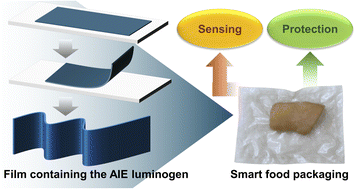
Packaging is essential for preserving food quality by protecting against microbial contamination and environmental factors such as oxygen, moisture, and light. Polymers are widely used for food packaging due to their versatility, low cost, and ease of processing. Over the past several decades, biodegradable polymer films have been extensively developed, either by using naturally derived polymers or by chemically modifying conventional polymers to enhance their environmental degradability. These advances have improved the sustainability of packaging and reduced the environmental impact associated with polymer use. More recently, the integration of aggregation-induced emission (AIE) luminogens into biodegradable polymer films has further enabled multiple functionalities, including real-time monitoring of food spoilage. This review highlights strategies for incorporating AIE into biodegradable polymer matrices, summarizes current progress, and discusses key challenges and future opportunities involved.
- This article is part of the themed collection: Biodegradable Polymer-based Intelligent Food Packaging Systems
 Please wait while we load your content...


