


 PLATFORM UPDATE:


Exploring the effect of dehulling and malting on the antioxidant properties, phenolic composition, and metabolite profile of Bambara groundnut (Vigna subterranea) flour obtained from three varieties
 *a
Nakisani Babra
Moyo
a
and
*a
Nakisani Babra
Moyo
a
and
Abstract
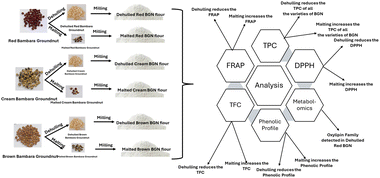
Bambara groundnut (Vigna subterranea) is an under-exploited legume with significant nutritional potential and is known for its adaptability to challenging environmental conditions. This study evaluated the effects of dehulling and malting on the antioxidant properties, and the phenolic and metabolite profiles of Bambara groundnut (BGN) flours derived from three distinct varieties (cream, brown, and red). The antioxidant properties and phenolic profiles of BGN flour were determined using standard methods. On the other hand, the metabolomic profile of BGN flour was determined using liquid chromatography-quadrupole time-of-flight mass spectrometry (LC-qTOF-MS). Malting significantly enhanced the total phenolic content (TPC), with malted brown and red varieties having a higher value of 0.43 mg GAE/g. Furthermore, the total flavonoid content (TFC) of malted BGN flours was higher, with values ranging from 0.27 (malted cream) to 0.49 mg QE/g (malted red). Malting also increased the antioxidant activity (DPPH and FRAP) of BGN flour. On the other hand, dehulling decreased (p < 0.05) the TPC and TFC of BGN flour, and the values ranged between 0.23 (control cream) to 0.15 mg GAE/g (dehulled cream) and TFC from 0.26 (control brown) to 0.23 mg QE/g (dehulled brown) and 0.32 (control red) to 0.26 mg GAE/g (dehulled red variety). Moreover, dehulling decreased the DPPH and FRAP of the BGN flour. Both processing methods increased (p < 0.05) the levels of protocatechuic and syringic acids in the red BGN variety. Malting also increased (p < 0.05) the vanillic and ferulic acid contents of the red BGN variety. Both processing methods decreased most phenolic acids in the BGN flour samples. Dehulling and malting showed some notable differences in the metabolic profile of BGN, particularly for the red variety, while the other two varieties showed only minor differences. Dehulling was observed to increase oxylipins in red BGN, with much lower levels detected in malted and whole samples.
 Please wait while we load your content...


