


 PLATFORM UPDATE:

Formulation of casein–curcumin nanodispersions using microfluidization and nano-precipitation methods: cytotoxicity and in vitro release in a mango drink
 b
Narashans Alok
Sagar
*de
b
Narashans Alok
Sagar
*de
Abstract
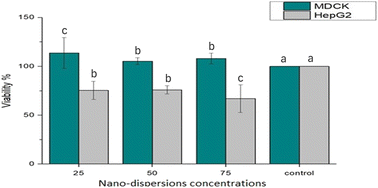
Curcumin is a bioactive compound obtained from turmeric (Curcuma longa). It has several biological properties, such as antioxidant, anti-inflammatory, antimicrobial and anticancer activities. The therapeutic efficacy and bioavailability of curcumin are low due to its poor water solubility and instability. Nanoencapsulation has emerged as a promising approach for curcumin delivery in food systems that can address the aforementioned challenges. In this study, casein–curcumin nanodispersions were developed by two different technologies, microfluidization and nano-precipitation, to enhance the stability, cytocompatibility and the controlled release of curcumin in a mango-based beverage. The results showed that the nanoparticles made from nanoprecipitation were bigger than those made from microfluidization. The PDI values showed that the microfluidized particles were more uniform in size, while the nano-precipitated ones were almost uniform. The zeta potential of the nanoprecipitated particles (−23.63 mV) showed that they were more stable than the microfluidized particles, which had lower values (−13.5 mV and −8 mV). Cytotoxicity was assessed using the MDCK (normal) and HepG2 (cancer) cell lines, indicating that the curcumin nanoparticles reduced cancer cell viability, particularly at higher concentrations, while maintaining a high biocompatibility with normal cells. From the in vitro release analysis, the nanoprecipitated curcumin dispersions exhibited a more controlled and sustained release in the mango drink than the microfluidized samples, which exhibited a faster initial release. Overall, our results show that the casein–curcumin nanodispersions produced by both methods (the nanoprecipitation and microfluidization methods) hold potential as effective functional food ingredients for targeted and sustained curcumin delivery.
 Please wait while we load your content...


