


 PLATFORM UPDATE:

Curcumin encapsulation via protein-stabilized emulsions: comparative formulation and characterization using whey, soy, and pea proteins
 *a
Kamalesh Kumar
Meena
c
and
*a
Kamalesh Kumar
Meena
c
and
Abstract
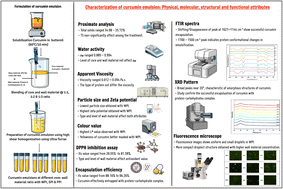
Curcumin, a potent polyphenol, has significant limitations in food and pharmaceutical applications due to its poor water solubility, chemical instability, and low oral bioavailability. To address these challenges, this study aimed to develop and systematically characterize stable emulsion-based curcumin delivery systems using a comparative approach. The present study offers novel findings through a direct, side-by-side evaluation of a traditional milk protein (whey protein isolate, WPI) against two plant-based alternatives (soy protein isolate, SPI, and pea protein isolate, PPI) under uniform formulation conditions. The emulsions were formulated with curcumin (0.4%) in butter oil as the lipophilic core, with WPI, SPI, or PPI, and a combination of maltodextrin and gum arabic as wall materials at core-to-wall ratios of 1 : 1, 1 : 2, and 1 : 3. The WPI-based emulsions demonstrated superior physicochemical properties, achieving the lowest particle size (322 ± 5.49 μm) and highest zeta potential (−38.50 mV) at the 1 : 2 ratio. PPI-based emulsions exhibited the highest antioxidant activity, with 81.38% DPPH inhibition, highlighting their potential as a promising plant-based alternative. Both dairy and plant proteins effectively encapsulated curcumin, with an encapsulation efficiency of 88.16–96.26%. In contrast, the SPI-based emulsions exhibited relatively lower performance across most parameters. FT-IR spectroscopy and fluorescence microscopy confirmed successful curcumin encapsulation and emulsion integrity. These findings highlight WPI as a highly effective encapsulating agent and position PPI as a viable, sustainable, and functional plant-based alternative. This study provides valuable insights for developing stable, cost-effective, and functional curcumin delivery systems to meet the growing market demand for clean-label and plant-based foods and nutraceuticals.
 Please wait while we load your content...


