


 PLATFORM UPDATE:

Sustainable enhancement of conjugated linoleic acid (CLA) production in lactic acid bacteria cocultures via ethanol permeabilization
 *a
*a
Abstract
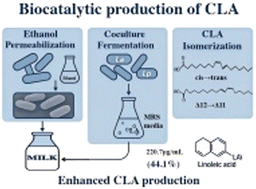
Conjugated linoleic acid (CLA) is a highly value added active lipid that could be utilized as a functional food ingredient. This study introduces an innovative, low-energy biocatalytic approach utilizing lactic acid bacteria (LAB) to enhance CLA production in a sustainable manner. A synergistic coculture of Lactobacillus acidophilus (La) and Lactobacillus plantarum (Lp) was developed, wherein La's rapid acidification (pH < 5.5) effectively activated Lp's linoleate isomerase (LAI). Notably, a food-grade ethanol-based permeabilization method—a non-invasive and environmentally friendly processing technique—was applied to modify cell membranes (confirmed via SEM), thereby facilitating efficient uptake and intracellular conversion of linoleic acid (LA) by LAI, resulting in both cis → trans and Δ12 → Δ11 isomerization. The coculture of La : Lp in MRS media containing 500 µg mL−1 LA exhibited a CLA conversion of 41.3%. When permeabilized cells were used in skim milk—an underutilized dairy byproduct—the CLA yield increased to 220.7 µg mL−1 (44.1% conversion), demonstrating the potential for direct integration into dairy fermentation processes. This research establishes ethanol permeabilization as a promising tool in circular bioengineering, enabling energy-efficient CLA production (<50 °C, no toxic reagents) with minimal process waste, offering new opportunities for the production of CLA-enhanced milk products.
- This article is part of the themed collections: Conference Collection for the 5th International Symposium of Food Science and Nutrition Health and 2026 Chinese New Year and Lunar New Year Collection: Food
 Please wait while we load your content...


