


 PLATFORM UPDATE:


Real-time prediction of shelf-life of soymilk using a surface-enhanced Raman spectroscopy (SERS) fiber and convolutional neural networks

Abstract
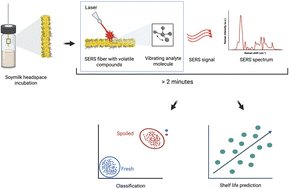
Predicting the shelf-life of food is important for reducing food waste and ensuring consumer safety. The shelf-life of food products is predicted using models generated from data obtained from microbial, flavor, compositional and sensory analyses. However, these methods are laborious, expensive, time-consuming, and impractical for real-time analyses. In this study, a surface-enhanced Raman spectroscopy (SERS) fiber was used together with convolutional neural networks (CNNs) to develop models and predict the remaining shelf-life of soymilk during accelerated storage at 25 °C. The fiber detected the presence of different volatile organic compounds (VOCs) and varying concentrations of dimethyl sulfide during storage. In the early days of storage (days 0–5), the presence of VOCs responsible for the beany and grassy odor typical of soymilk was detected. On day 9, the presence of ketones, esters and some aldehydes was detected in the headspace. Using CNN models, the SERS spectra showed strong correlations with key quality and safety indicators including optical density (R = 0.85, RMSE = 0.04), pH (R = 0.87, RMSE = 0.32), microbial count (R = 0.91, RMSE = 0.69 log10 CFU ml−1), electrical conductivity (R = 0.92, RMSE = 0.07 mV), particle size (R = 0.94, RMSE = 212.59 nm), and zeta-potential (R = 0.94, RMSE = 1.28 mS cm−1). The SERS spectra also showed strong correlations with the remaining shelf-life (R = 0.95, RMSE = 1.30 days). Separate spectra were used to externally validate the remaining shelf-life and microbial count models. The results demonstrated strong predictive performance, with the model achieving accurate predictions for the remaining shelf-life and microbial count. These findings support the potential of the SERS fiber–CNN approach for practical shelf-life prediction. More tests are needed for different food products and conditions.
 Please wait while we load your content...


