


 PLATFORM UPDATE:

Development and characterization of a functional nanoemulsion using pomelo peel essential oil and curcumin
 a
and
Poonam
Mishra
*a
a
and
Poonam
Mishra
*a
Abstract
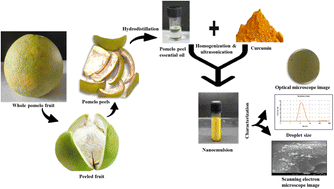
Pomelo peel essential oil and curcumin possess potent antioxidant, anti-inflammatory, and antimicrobial properties. However, their poor solubility and instability limit their practical applications. To overcome these challenges, a nanoemulsion incorporating both bioactives was formulated and optimized using a Box–Behnken design. Essential oil, Tween 80, and curcumin were selected as independent variables, with DPPH radical scavenging activity, turbidity, and stability as response parameters. The optimized formulation was achieved at 15 mL essential oil, 5 mL Tween 80 and 0.10 g curcumin, with a desirability of 0.772. This desirability indicates that the optimized formulation fulfils the desired goals of selected independent variables and shows predicted versus experimental values with less than 10% deviation, confirming model adequacy. The nanoemulsion exhibited a droplet size of 12.98 nm ± 0.65 nm, a polydispersity index of 0.287 ± 0.008, and a zeta potential of −22.4 ± 0.20 mV, indicating good physical stability. Color measurements (L* = 75.59, a* = 4.52, b* = 79.78) reflected uniform dispersion of components. The formulation showed strong antioxidant activity, elevated total phenolic and flavonoid contents, and effective antimicrobial action against common pathogens. The optimized nanoemulsion showed inhibition zones of 15, 18, 20, 16 and 19 mm against Bacillus cereus, Salmonella typhimurium, Staphylococcus aureus, Pseudomonas aeruginosa, and Escherichia coli, respectively. It remained stable at room temperature for one month without phase separation. These results highlight the potential of the developed nanoemulsion as a functional ingredient for food applications. This study highlights the sustainable utilization of pomelo peel, a by-product of the pomelo fruit after consumption, by harnessing it for essential oil extraction.
 Please wait while we load your content...


