


 PLATFORM UPDATE:


Formation and characteristics of large yellow croaker (Pseudosciaena crocea) roe protein isolates/gellan gum composite gels: effects of pH and mass ratio
 a
and
Hai-Tao
Wu
*a
a
and
Hai-Tao
Wu
*a
Abstract
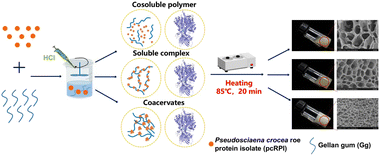
Large yellow croaker (Pseudosciaena crocea) roe protein isolates are excellent marine-derived functional proteins. To expand the application of pcRPI in the food industry, the effects of pH and mass ratio on the complex coacervation of pcRPI with gellan gum (Gg) was discussed. According to the turbidity titration results, the pH values for the formation of soluble complexes and complex coacervates increased and then tended to plateau with an increase in the pcRPI/Gg mass ratio. Moreover, the pcRPI/Gg gels were prepared at a pcRPI : Gg mass ratio of 10 : 1 at different pH values chosen from different phases (6, 8 and 10). The pcRPI/Gg formed a gel at pH 6, showing the highest storage modulus (G′) value, which was 2.5-fold and 12.1-fold higher than those at pH 8 and pH 10, respectively. The addition of Gg significantly improved the gelation behavior of pcRPI, enabling stable gel formation at pH 6, a condition under which the protein alone could not form a gel. The molecular simulation results revealed the binding patterns between pcRPI and Gg under different pH conditions, highlighting the critical role of hydrogen bonding in stabilizing the complexes. This study offers theoretical guidance for the application of pcRPI and Gg based coacervation in the field of food gels.
- This article is part of the themed collection: Conference Collection for the 5th International Symposium of Food Science and Nutrition Health
 Please wait while we load your content...


