


 PLATFORM UPDATE:

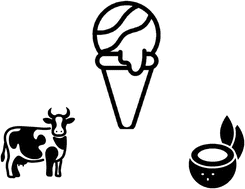
From cow to coconut: a literature review of the environmental cost of ice cream
 *b
*b
Abstract
Ice cream's environmental impacts are often attributed to dairy inputs and energy-intensive refrigeration, yet published life cycle assessments (LCAs) report wide ranges of results due to inconsistent scopes and system boundaries. This review synthesizes LCAs of dairy and plant-based ice cream to identify key hotspots and actionable steps for impact reduction. We screened and synthesized studies by functional unit (1 kg product), aligned system boundaries (cradle-to-gate vs. cradle-to-grave), and offer a practical mitigation roadmap for dairy and plant-based ice cream production. Across dairy formulations, reported carbon footprints span 0.36–0.97 kg CO2e per kg (cradle-to-gate) and 3.36–4.00 kg CO2e per kg (cradle-to-grave). Ingredients dominate about 42–70% of the total impact, driven largely by raw milk supply; farm-gate milk alone averages 1.4–1.8 kg CO2e per kg Fat- and Protein-Corrected Milk (FPCM), explaining much of the ingredient hotspot. The cold chain (freezing, storage, retail) is the second major hotspot, contributing up to 46% of the total impact, followed by packaging at about 8%. In contrast, the only available study on coconut-milk ice cream reported 1.17 kg CO2e per kg cradle-to-gate with coconut waste as the largest greenhouse gas emissions driver, contributing 53.73% of total emissions, which is actually higher than the average dairy impact of 0.36–0.97 kg CO2e per kg cradle to gate, highlighting how scope and boundaries affect results and make it difficult to draw meaningful conclusions. Hence, needed future research includes (i) future studies should explicitly define system boundaries and scopes, (ii) assess multiple impact categories to avoid burden shifting, (iii) reduce emissions from milk production, thus, targeting fertilizer management in feed crops, covered storage and enteric-methane mitigation, and (iv) cold-chain optimization, including raising the freezing point of ice cream form −18 to−12 °C, an intervention linked to about 20–30% energy savings. Also, integrating social LCA would resolve the current gap between community effects, stated preferences and realized sustainability outcomes.
- This article is part of the themed collection: Celebrating International Women’s Day 2026: Women in Sustainable Food Technology
 Please wait while we load your content...


