


 PLATFORM UPDATE:

Green extraction of phenolic compounds and carotenoids from the pulp and peel of mango criollo by sustainable emerging technologies
 *a
Gonzalo Adrián
Ojeda,
b
Begoña
Olmedilla-Alonso,
c
Concepción
Sánchez-Moreno,
d
*a
Gonzalo Adrián
Ojeda,
b
Begoña
Olmedilla-Alonso,
c
Concepción
Sánchez-Moreno,
d
Abstract
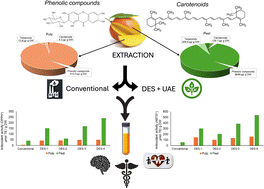
The present study investigates the recovery of bioactive compounds from underutilized and non-commercial mango criollo by using sustainable technologies. Deep eutectic solvents (DES) [β-alanine (β-Ala) with malic acid (DES-1) and citric acid (DES-2) and choline chloride (ChCl) with ethylene glycol (DES-3) and glycerol (DES-4)] combined with ultrasound-assisted extraction (UAE) [500 W–20 kHz at 36 μm/6 min for peel and at 45 μm/30 min for pulp] (DES-UAE) successfully isolated phenolic compounds, carotenoids, and terpenoids from mango criollo pulp and peel. Conventional extraction yielded 10 times more phenolic compounds and 3 times more carotenoids in the peel than in the pulp. ChCl-based DES significantly improved the extraction of phenolic compounds and antioxidant activity in both pulp and peel compared to conventional extraction (stirring with aqueous ethanol). Total phenolic compounds in peel with DES-4 (4.71 mg g−1 DW) and in pulp with DES-2 (0.87 mg g−1 DW) represented the best results with increases of 29% and 72%, respectively, compared to conventional extraction. Carotenoid recovery in pulp was similar between methods, while in the peel, the conventional extraction (stirring with diethyl ether/petroleum ether) was superior. All DES in pulp recovered ∼85% of the carotenoids that conventional methods yielded (42.74 μg g−1 DW), but DES in peel were less effective than conventional extraction (129.70 μg g−1 DW), where the best result was with β-Ala-based DES-2 that extracted 71% of the carotenoids obtained by conventional extraction. DES-UAE presents a promising, eco-friendly alternative for extracting valuable compounds from mango waste, supporting applications in the food industry while reducing environmental impact.
 Please wait while we load your content...


