


 PLATFORM UPDATE:


Fabrication of blue emissive carbon dots using Morinda citrifolia fruit pulp for clodinafop and cypermethrin detection via fluorescence turn-off and enhancement mechanisms
 c
and
Suresh Kumar
Kailasa
*a
c
and
Suresh Kumar
Kailasa
*a
Abstract
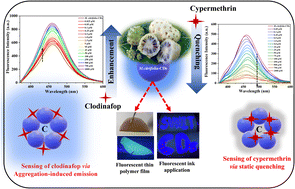
The advancement in the field of fluorescence sensing requires the fabrication of superior nanoprobes that can quantify pesticides (clodinafop and cypermethrin) at trace levels for human health and environmental sustainability. Herein, blue emissive carbon dots (CDs) were fabricated using the ripe fruit pulp of Morinda citrifolia (M. citrifolia) as a biological ligand. The synthesized M. citrifolia-CDs possess blue fluorescence under UV light and exhibit excitation-independent emission behaviour at 340 nm across an excitation range of 300–400 nm, showing optimum emission intensity at 456 nm. The as-synthesized M. citrifolia-CDs show high water dispersibility and good stability for up to 100 days. The dynamic light scattering and zeta potential values of the as-synthesized CDs were found to be 7.17 nm and −37.3 mV, respectively, which showed remarkable changes after the addition of target pesticides. The introduction of clodinafop enhanced the fluorescence intensity, whereas the fluorescence was quenched by the addition of cypermethrin. The probe depicts remarkable sensitivity with limits of detection (LODs) of 0.079 and 0.028 μM for clodinafop and cypermethrin, respectively. The M. citrifolia-CDs acted as a selective nanoprobe for detection of clodinafop and cypermethrin and do not show any major fluorescence in the presence of chemical interfering agents. The as-synthesized CDs have been used for the fabrication of polymer thin films and fluorescent ink.
- This article is part of the themed collection: Celebrating International Women’s Day 2026: Women in Sustainable Food Technology
 Please wait while we load your content...


