


 PLATFORM UPDATE:

Green extraction technologies for valorising Brazilian agri-food waste
 a
Thatyane Vidal
Fonteles,
b
Fabiano A. N.
Fernandes
a
and
Sueli
Rodrigues
*b
a
Thatyane Vidal
Fonteles,
b
Fabiano A. N.
Fernandes
a
and
Sueli
Rodrigues
*b
Abstract
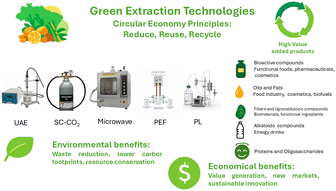
Brazil generates a large amount of agri-food waste due to its extensive agricultural and food processing activities, presenting both an environmental challenge and an opportunity for value generation. This review examines the current status and key challenges associated with food waste in Brazil, exploring how principles of the circular economy can be applied to address these issues. Emphasis is placed on the use of green extraction technologies to recover valuable bioactive compounds from agricultural byproducts, with applications across the food, pharmaceutical, and cosmetic sectors. A critical evaluation of various extraction methods, including those utilizing green solvents and energy-efficient processes, reveals that while promising, the effectiveness of these techniques varies significantly depending on the specific methodology employed. Different extraction approaches yield extracts with distinct compositions, underscoring the importance of comparative studies and process optimization. By aligning waste management practices with circular economy principles, Brazil can position itself as a leader in sustainable agricultural and food innovation.
 Please wait while we load your content...


