


 PLATFORM UPDATE:

Valorization of areca nut husk and water hyacinth fibers into biodegradable plates for sustainable packaging

Abstract
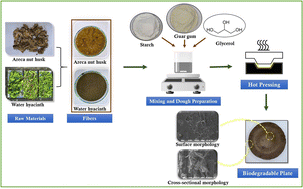
This study investigates the development of biodegradable plates using cellulose fibers derived from areca nut husk and water hyacinth, aiming to create an eco-friendly alternative to conventional plastic plates and mitigate environmental concerns associated with non-degradable packaging. Raw fibers from both sources were treated with an alkali solution to enhance surface properties. Alkali-treated fibers from both sources were blended in various proportions, doped with starch as a binding agent, and processed via thermo-expansion to develop biodegradable plates. Alkali treatment showed significant improvements in the physical properties of both areca nut husk and water hyacinth fibers. Specifically, for areca nut husk, the moisture content dropped from 13.19 ± 1.21% to 9.43 ± 0.97%, bulk density increased from 0.137 ± 0.012 to 0.828 ± 0.030 g cm−3, and the water absorption index decreased from 8.59 ± 0.77 to 6.69 ± 0.32 g g−1. In parallel, water hyacinth fibers showed a reduction in moisture content from 14.76 ± 0.86% to 10.54 ± 0.69%, an increase in bulk density from 0.159 ± 0.008 to 0.413 ± 0.013 g cm−3, and a decline in the water absorption index from 10.34 ± 0.33 to 6.14 ± 0.41 g g−1. Among the tested formulations, plates made from a 50 : 50 blend of alkali-treated areca nut husk and water hyacinth fibers exhibited desirable properties like a thickness of 1.93 ± 0.06 mm, grammage of 1315.67 ± 20.55 g m−2, bulk density of 0.18 ± 0.02 g cm−3, moisture content of 10.27 ± 0.26%, water absorptiveness of 481.33 ± 61.04 g m−2, and tensile strength of 3.99 ± 0.31 MPa. Furthermore, coating with beeswax significantly improved the water resistance and overall properties of the plate. Biodegradability tests revealed that plates exposed to soil exhibited nearly 70–75% mass loss within 6 weeks. This innovative approach not only offers a practical solution for sustainable packaging but also addresses the environmental challenges posed by agricultural waste and invasive plant species.
 Please wait while we load your content...


