Sustainable valorization of porcine placenta through microencapsulation: a circular economy approach to functional ingredient development

Abstract

The increasing volume of porcine placenta, a nutrient-rich slaughterhouse byproduct, poses waste management challenges in Thailand's expanding pork industry. This study aimed to valorize porcine placenta by extracting bioactive compounds and developing shelf-stable microcapsules for functional food and pharmaceutical applications. Hexane-based fat removal reduced protein content by 24% and antioxidant activity (DPPH: 2.61 ± 0.08 mM TE/g db; FRAP: 4.80 ± 0.27 mM FeSO4/g db) but preserved protein profiles (25–100 kDa). Spray drying with gum arabic (40% w/v, 165 °C inlet temperature) achieved the highest protein retention (3.93 mg/g) and encapsulation efficiency (97.99%), producing microcapsules with low water activity (0.08–0.11), moisture content (2.28–4.08%), and glass transition temperatures (44.1–61.5 °C). Vacuum-sealed aluminum foil packaging maintained quality over 90 days at room temperature. This novel approach upcycles animal-derived waste into a stable, bioactive ingredient, advancing circular economy principles by reducing waste and offering sustainable applications in food and nutraceutical sectors.
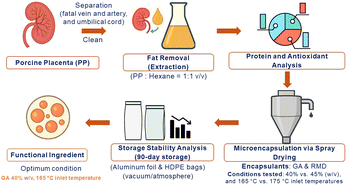
Graphical abstract: Sustainable valorization of porcine placenta through microencapsulation: a circular economy approach to functional ingredient development

Transparent peer review

To support increased transparency, we offer authors the option to publish the peer review history alongside their article.

View this article’s peer review history

Article information

Article type
Paper
Submitted
17 Jun 2025
Accepted
09 Sep 2025
First published
15 Sep 2025
This article is Open Access
Creative Commons BY-NC license

Sustainable Food Technol., 2026, Advance Article

Sustainable valorization of porcine placenta through microencapsulation: a circular economy approach to functional ingredient development

P. Chulalaksananukul, S. Jafari, K. A. Shiekh, I. Kijpatanasilp, N. Pholmanee, P. Harnvoravongchai, T. Janvilisri and K. Assatarakul, Sustainable Food Technol., 2026, Advance Article , DOI: 10.1039/D5FB00277J

This article is licensed under a Creative Commons Attribution-NonCommercial 3.0 Unported Licence. You can use material from this article in other publications, without requesting further permission from the RSC, provided that the correct acknowledgement is given and it is not used for commercial purposes.

To request permission to reproduce material from this article in a commercial publication, please go to the Copyright Clearance Center request page.

If you are an author contributing to an RSC publication, you do not need to request permission provided correct acknowledgement is given.

If you are the author of this article, you do not need to request permission to reproduce figures and diagrams provided correct acknowledgement is given. If you want to reproduce the whole article in a third-party commercial publication (excluding your thesis/dissertation for which permission is not required) please go to the Copyright Clearance Center request page.

Read more about how to correctly acknowledge RSC content.

Social activity

Spotlight

Advertisements