Hyaluronic acid/chitosan/pectin based edible composite antioxidant coatings for the preservation of fresh apricots

Abstract

Apricots have a considerably short shelf-life with high sensitivity to degradation. In this study, hyaluronic acid is blended with pectin and chitosan to produce active edible coatings for the preservation of fresh postharvest apricots and extend their shelf-life. The objective of this study is to study the interplay between hyaluronic acid and pectin in edible coatings. The blended coatings are designed to take advantage of the antioxidant properties of both hyaluronic acid and pectin. The fruit preservation effectiveness of developed coatings is investigated over a 21 days storage period. The developed edible coatings exhibit significant fruit preservation characteristics in terms of weight loss, pH, titratable acidity and total solids content, and maintaining the antioxidant properties of coated fruits as measured through total phenolic content, change in ascorbic acid content and 2,2-diphenyl-1-picrylhydrazyl (DPPH) assay compared to uncoated control fruits. We observed that a fine balance between the amount of hyaluronic acid and pectin is required to achieve optimal fruit preservation during the 21 days of storage with the best performance recorded for coatings containing marginally higher concentration of hyaluronic acid than pectin.
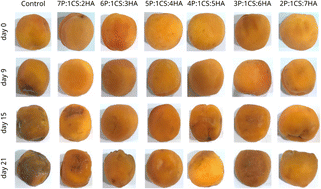
Graphical abstract: Hyaluronic acid/chitosan/pectin based edible composite antioxidant coatings for the preservation of fresh apricots

Article information

Article type
Paper
Submitted
04 Jun 2025
Accepted
15 Oct 2025
First published
16 Oct 2025
This article is Open Access
Creative Commons BY-NC license

Sustainable Food Technol., 2026, Advance Article

Hyaluronic acid/chitosan/pectin based edible composite antioxidant coatings for the preservation of fresh apricots

A. A. Al-Temimi, S. A. Al-Hilifi, R. M. Al-Ali, L. N. M. Dinh, Y. Yao and V. Agarwal, Sustainable Food Technol., 2026, Advance Article , DOI: 10.1039/D5FB00254K

This article is licensed under a Creative Commons Attribution-NonCommercial 3.0 Unported Licence. You can use material from this article in other publications, without requesting further permission from the RSC, provided that the correct acknowledgement is given and it is not used for commercial purposes.

To request permission to reproduce material from this article in a commercial publication, please go to the Copyright Clearance Center request page.

If you are an author contributing to an RSC publication, you do not need to request permission provided correct acknowledgement is given.

If you are the author of this article, you do not need to request permission to reproduce figures and diagrams provided correct acknowledgement is given. If you want to reproduce the whole article in a third-party commercial publication (excluding your thesis/dissertation for which permission is not required) please go to the Copyright Clearance Center request page.

Read more about how to correctly acknowledge RSC content.

Social activity

Spotlight

Advertisements