


 PLATFORM UPDATE:

Foam mat drying of perishable products: a critical review of process parameters, product quality, and sustainable prospects
 *ab
and
*ab
and
Abstract
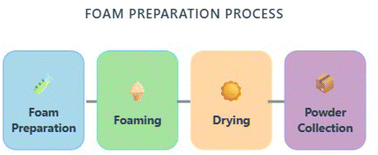
Foam mat drying (FMD) is emerging as a cost-effective and energy-efficient technology for preserving heat-sensitive perishable products such as fruits, vegetables, dairy formulations, and protein-rich matrices. By incorporating air into liquid or semi-solid substrates, foam mat drying enhances surface area, accelerates drying kinetics, and improves retention of nutritional, structural, and sensory attributes. While previous reviews have discussed foam mat drying in general terms, a focused, parameter-specific evaluation across diverse food categories remains limited. This review provides an in-depth analysis of critical process parameters, such as foaming agent type and concentration, whipping time, foam thickness, drying temperature, and air velocity, and their effects on product quality indicators, including nutrient retention, rehydration ability, color stability, and shelf-life. The inclusion of comparative data tables, impact matrices, and decision-support tools offers actionable insights for optimizing drying protocols. Notably, this review integrates advanced modeling techniques, including response surface methodology (RSM), artificial neural networks (ANNs), and machine learning algorithms to predict drying behavior and maximize process efficiency. Sustainability considerations such as energy consumption, environmental impact, and the use of bio-based foaming agents are also critically examined. This review bridges scientific research and industrial practice, serving as a comprehensive resource for food scientists, technologists, and stakeholders in sustainable food processing.
 Please wait while we load your content...


