


 PLATFORM UPDATE:

Rosemary oil infused bionanocomposite films: a sustainable and active packaging material for paneer preservation
 ab
and
Maya
Raman
*a
ab
and
Maya
Raman
*a
Abstract
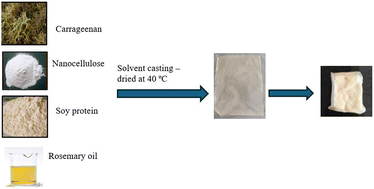
The present study investigates the development of bionanocomposite films formulated using carrageenan (1.9% w/v), soy protein (0.3% w/v) and nanocellulose (2% w/v), with rosemary essential oil (REO, 1–2% v/v) incorporated as a bioactive agent. The incorporation of 2% REO significantly reduced the tensile strength (23.7 MPa) but increased elongation at break (19.8%), enhancing flexibility. The hydration properties decreased (moisture content 15.5%, swelling capacity 14.5%, water vapour transmission rate 644.4 g m−2 24 h−1), confirming superior moisture barrier performance. Fourier-transform infrared spectroscopy indicated strong polymer–polymer interactions, while SEM revealed oil droplet dispersion within the matrix. The films with 2% REO showed the highest antimicrobial activity, notably against Bacillus cereus (25 mm inhibition zone), attributable to phenolic constituents (α-pinene, 1,8-cineole, camphor). The films achieved 90% soil biodegradability after 28 days, underscoring their environmental sustainability. The application studies demonstrated that paneer packaged in 2% REO films maintained superior quality during 28 days of refrigeration (4 °C), with lower moisture (42.8%), titratable acidity (0.7%), tyrosine content (23 mg/100 g), improved colour (L*-75.2, a*-3.5, b*-19.2) with textural parameters, hardness (69 N) and chewiness (9.8 N) respectively. Overall, carrageenan/soy protein/nanocellulose films with REO represent a multifunctional, biodegradable, and sustainable system for active food packaging.
 Please wait while we load your content...


