


 PLATFORM UPDATE:


Natural-sunlight-harvesting benzothiadiazole-based molecular photocatalyst for H2O2 production: a recyclable homogeneous biphasic system
 a
Saumi
Ray
*a
a
Saumi
Ray
*a
Abstract
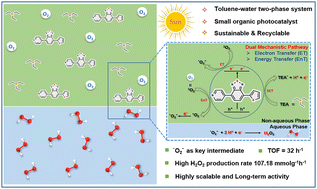
Photocatalytic hydrogen peroxide (H2O2) synthesis offers a sustainable route for solar-to-chemical energy conversion to address the increasing global energy demand. However, developing an efficient and sustainable photocatalytic system for H2O2 synthesis remains a critical bottleneck. Herein, we report a unique toluene–water two-phase system for highly efficient H2O2 synthesis, employing a benzothiadiazole-based small organic photocatalyst, Py–BT–Th. Py–BT–Th shows a high H2O2 production rate of 107.18 mmol g−1 h−1, with a turnover frequency of ∼32 h−1, under natural sunlight irradiation in the toluene–water biphasic system, which uses triethylamine as a sacrificial agent. The biphasic system promotes H2O2 mass transport, leading to rapid kinetics across the toluene–water interface. Experimental studies reveal that the superior photocatalytic performance of the catalyst Py–BT–Th is attributed to its donor–acceptor-type molecular architecture, which promotes efficient exciton separation, high molar absorptivity (ε = 12.27 × 10³ M−1 cm−1), long exciton lifetime (12.9 ns) and broad light-harvesting capacity. Scavenger and in situ EPR spectroscopic studies confirm that Py–BT–Th produces H2O2 by following a dual mechanistic route: (1) indirect two-step one-electron ORR via an electron transfer pathway and (2) singlet-oxygen generation via an energy transfer pathway. In both the routes, ˙O2− is the key intermediate that ultimately gets converted into hydrogen peroxide, in association with the oxidation of triethylamine by photogenerated holes. Overall, this work disentangles the dilemma associated with small organic photocatalysts for H2O2 synthesis through a recyclable toluene–water biphasic system.
 Please wait while we load your content...


