


 PLATFORM UPDATE:

Learning in higher dimensions: a strategy for alloy electrocatalyst discovery
 †ab
Jack K.
Pedersen,
†c
Gustav K. H.
Wiberg,
a
Kirsten M. Ø.
Jensen,
c
Jan
Rossmeisl
*c
and
†ab
Jack K.
Pedersen,
†c
Gustav K. H.
Wiberg,
a
Kirsten M. Ø.
Jensen,
c
Jan
Rossmeisl
*c
and
Abstract
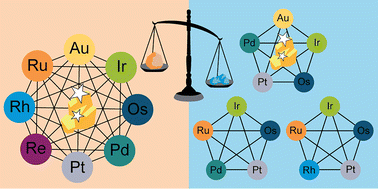
In this work, we demonstrate the inversion of the classical bottom-up approach to drive the discovery of improved energy conversion electrocatalysts top-down. Starting with complex alloy catalysts of many constituents, we down-select to optimal materials by removing low-performing elements from the alloy. The efficiency of this data-driven approach arises from the fact that when studying many elements together in one material, information is also obtained on the less complex alloys that contain fewer constituents. Therefore, the number of experiments required to study the complex alloy is fewer than those needed for studying all constituent alloys individually. In addition, this top-down approach allows for a new way of comparing activity models constructed from experimental data with theoretical simulations. We introduce the approach by studying the Au–Ir–Os–Pd–Pt–Re–Rh–Ru high entropy alloy (HEA) composition space for the acidic oxygen reduction reaction (ORR). By studying 200 compositions, we created a machine-learned activity model and provide evidence that the model can predict the activity of underlying, less complex compositions that are contained in the Au–Ir–Os–Pd–Pt–Re–Rh–Ru HEA composition space.
- This article is part of the themed collections: EES Catalysis Recent HOT articles and Catalysis and Materials for Sustainable Energy
 Please wait while we load your content...


