


 PLATFORM UPDATE:


Does the pre-catalyst shape matter in the electrocatalytic reduction of CO2? Tracking mosaicity and porosity development in Cu2O particles during reaction
 *a
and
Beatriz
Roldan Cuenya
*a
*a
and
Beatriz
Roldan Cuenya
*a
Abstract
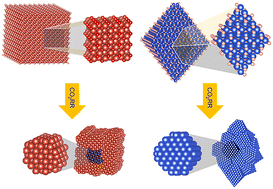
Copper (Cu) is an important catalyst material for driving the electrocatalytic reduction of CO2 (CO2RR) into hydrocarbons. Particularly, oxide-derived Cu catalysts generally exhibit higher catalytic selectivity toward hydrocarbons compared to metallic Cu pre-catalysts but the degree to which the initial pre-catalyst surface facet structure affects the catalyst activity and selectivity remains unclear. This is in part due to the non-controlled dynamic and kinetic transformations that these catalysts undergo during electrocatalysis. In this study, we followed the restructuring of cubic and octahedral Cu2O pre-catalyst particles during the CO2RR using liquid cell transmission electron microscopy and ex situ identical location electron diffraction. We found that both shapes fragment into smaller interconnected Cu domains with different preferred domain orientations to accommodate the strain resulting from the lattice contraction caused by the abrupt removal of oxygen during the CO2RR. Nonetheless, a comparison of the product selectivity between the electrodeposited Cu2O cubes and octahedra with initially similar sizes and surface loadings, but different shapes, unveiled minimal differences in their catalytic performance. Hence, our results indicate that the structural complexity that arises during the initial stages of the CO2RR, including particle fragmentation creating mosaicity and porosity and the concurrent re-deposition altering the working catalyst distribution, is the primary factor controlling the performance of oxide-derived Cu catalysts.
- This article is part of the themed collection: EES Catalysis Recent HOT articles
 Please wait while we load your content...


