


 PLATFORM UPDATE:


Industrial amine blends enable efficient CO electrosynthesis in reactive capture

Abstract
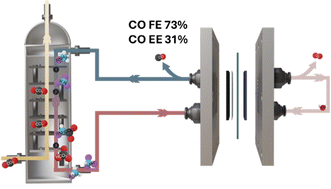
Reactive capture of CO2 (RCC) integrates CO2 capture and electrochemical conversion into carbon monoxide (CO), avoiding the energy-intensive CO2 regeneration required in conventional CO2 electrolysis. While single-component amines have been used in prior RCC systems, they suffer from limited CO energy efficiency (<15%) due to sluggish CO2 release. In contrast, the norm in industrial CO2 capture is to blend amines for a favorable combination of absorption rate, CO2 loading capacity, and release energetics. Here, we explore whether blending amines could likewise benefit reactive capture. Using aqueous blends of monoethanolamine (MEA) and methyldiethanolamine (MDEA), we find a strong correlation between bicarbonate concentration in the post-capture solution and CO faradaic efficiency (FE). However, under industrial absorption conditions, the blend with the highest bicarbonate content did not always yield the best CO FE: although MDEA increased bicarbonate concentrations, it also increased the viscosity, hindering CO2 mass transport and increasing cell resistance. These competing effects highlight that, for efficient RCC, the composition must balance CO2 absorption kinetics and capacity for capture, as well as CO2 availability and transport properties for conversion. Screening the performance of binary and commercial amine blends, we find a CO energy efficiency (EE) of 31% at 50 mA cm−2—a 2.4-fold improvement over single-amine systems.
- This article is part of the themed collection: EES Catalysis Recent HOT articles
 Please wait while we load your content...


