


 PLATFORM UPDATE:


Unlocking long-term stability in metal-based gas diffusion electrodes for CO2 electroreduction
 †a
Jia
Song,
†a
Ranjith
Prasannachandran,
a
Asier
Grijalvo,
a
Zhiyuan
Chen,
a
Jan
Vaes,
a
Yuvraj Y.
Birdja
*a
and
Deepak
Pant
*ab
†a
Jia
Song,
†a
Ranjith
Prasannachandran,
a
Asier
Grijalvo,
a
Zhiyuan
Chen,
a
Jan
Vaes,
a
Yuvraj Y.
Birdja
*a
and
Deepak
Pant
*ab
Abstract
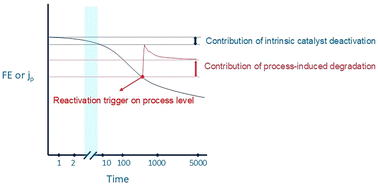
Electrochemical CO2 reduction (ECR) to formate/formic acid (FA) represents one of the most viable pathways for converting CO2 into value-added chemicals, particularly under industrially relevant conditions. However, long-term operational stability of gas diffusion electrodes (GDEs) at high current densities remains a critical bottleneck. Herein, we report the development of carbon-free bismuth (Bi) and tin (Sn)-based GDEs fabricated via a custom methodology that enables stable ECR operation for over 4000 hours (Bi) and 1050 hours (Sn) at 100 mA cm−2, achieving faradaic efficiencies (FE) of up to 90% and 70%, respectively. A comprehensive mechanistic investigation reveals that performance degradation is predominantly driven by dynamic changes in the bulk catholyte, particularly pH shifts and HCO3− ionic depletion, rather than intrinsic catalyst decay. Control experiments and in situ Raman spectroscopy highlight the formation and regeneration of bismuth subcarbonate species as key intermediates in the ECR process. The results demonstrate sustained operation with periodic reactivation, rather than static stability, highlighting how electrolyte management and pulsed electrolysis can extend system durability under industrially relevant conditions. Crucially, we demonstrate that a combination of catholyte refreshment and periodic anodic pulsing reactivates electrode performance, sustaining high selectivity and suppressing the hydrogen evolution reaction (HER) over extended durations.
 Please wait while we load your content...


