


 PLATFORM UPDATE:


Harnessing chirality in nanomaterials: advancing photocatalysis for hydrogen production and beyond
 a
Jeongwon
Kim,
a
Kyunghee
Chae,
a
Minju
Kim,
b
Zhiqun
Lin
*b
and
Dong Ha
Kim
*acd
a
Jeongwon
Kim,
a
Kyunghee
Chae,
a
Minju
Kim,
b
Zhiqun
Lin
*b
and
Dong Ha
Kim
*acd
Abstract
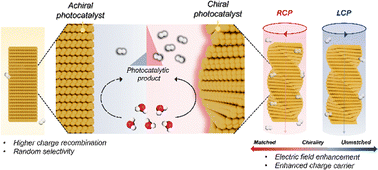
Solar-driven chemical conversion stands as a basis strategy for realizing sustainable energy technologies. Within this context, chiral photocatalysts have emerged as a new generation of materials that unify light–matter interactions with asymmetric molecular recognition. The integration of chirality into nanostructured systems introduces inherent structural and electronic asymmetry, enhancing light absorption, chiroptical activity and charge carrier dynamics. The cooperative effects collectively improve photocatalytic efficiency, particularly in solar-driven hydrogen evolution. In parallel, the chiral-induced spin selectivity (CISS) effect promotes spin-polarized charge transport, accelerates reaction kinetics and refines product selectivity. This review elucidates the mechanistic origins of chirality in catalyst design, encompassing molecular interactions, light-mediated induction and template-assisted synthesis. It evaluates recent advances in the characterization and construction of multiclass chiral photocatalysts, with emphasis on hydrogen evolution, alongside extensions to photocatalytic CO2, N2 reduction and other emerging reaction paradigms. The outlook presented herein underscores emerging opportunities for rationally designing chirality-driven photocatalysts as a transformative platform for next-generation solar-to-chemical energy conversion.
- This article is part of the themed collections: EES Catalysis Recent HOT articles, EES Catalysis 2026 Review Articles and Catalysis and Materials for Sustainable Energy
 Please wait while we load your content...


