


 PLATFORM UPDATE:


Tailoring electronic structures of Ni@N-doped carbon hollow urchins for dual-functional Zn–CO2 batteries and industrial CO2 electroreduction

Abstract
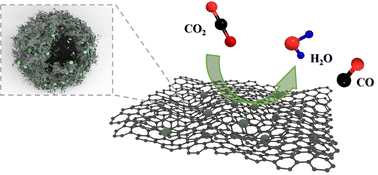
A catalyst with a hollow urchin-like sphere structure and porous surface was synthesized using Ni-MOF precursors (Ni@N-HCS). This catalyst features nickel nanoparticles encapsulated by nitrogen-doped carbon shells and exhibits excellent electrocatalytic activity in the CO2 reduction reaction (CO2RR). In a hybrid flow cell, the optimal catalyst attains an industrial current density of 174.23 mA cm−2 and a high CO Faraday efficiency (FECO) of 82.34%, along with good long-term stability. Moreover, when employed as the cathode in a Zn–CO2 flow battery, this catalyst achieves the highest power density of 11.55 mW cm−2 and demonstrates excellent cycling durability. According to density functional theory (DFT) calculations, the graphene-covered Ni cluster (Ni-ApyN) is identified as the most efficient active site for the CO2RR. This efficiency is attributed to the fact that pyridinic N-doped carbon shell encapsulating Ni nanoparticles (NPs) reduces the free energy of the reaction by modulating the electronic structure of Ni, thereby effectively accelerating the reaction kinetics rate. As a result, this work in both the hybrid flow cell and the Zn–CO2 flow battery offers a promising approach for energy storage and conversion.
 Please wait while we load your content...


