


 PLATFORM UPDATE:


Unraveling membrane electrode assembly design for electrochemical conversion of carbon dioxide to formate/formic acid
 a
Jacob A.
Wrubel,
*a
Paige Nicole
Brimley,
b
Leiming
Hu
a
and
Kenneth C.
Neyerlin
a
a
Jacob A.
Wrubel,
*a
Paige Nicole
Brimley,
b
Leiming
Hu
a
and
Kenneth C.
Neyerlin
a
Abstract
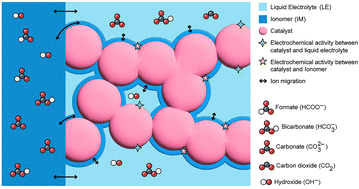
This work presents a one-dimensional continuum modeling approach to investigate various cell architectures used for electrochemical conversion of CO2 to formate/formic acid. Ion transport is simulated by a system of generalized modified Poisson–Nernst–Planck (GMPNP) equations that reflect the reactive transport phenomena including steric effects as the electrolyte solutions become concentrated. In the cathode catalyst layer, ionic current contributions from both the supporting electrolyte and solid-state ionomer are considered. Voltage and CO2 utilization breakdowns are utilized to deconvolute the impacts of the cell architecture. The origins of (bi)carbonate formation in the cathode are explored, as the subsequent decrease in CO2 availability is a key reason for low faradaic efficiencies to formate/formic acid. In addition, the role of a supporting electrolyte (KOH) is investigated to understand its tradeoffs: while the K+ ions can improve both conductivity and electrochemically active surface area in the cathode, the presence of OH− ions raises the pH and leads to deleterious formation of (bi)carbonates. To this end, we also present parametric studies on the concentration and flow rate of supplied KOH to the cell, to establish a path towards eliminating the need for a supporting electrolyte.
 Please wait while we load your content...


