Volume 4, 2026

Fe-modified CoCr layered double hydroxides for boosting the seawater oxygen evolution reaction

Abstract

The development of efficient and stable oxygen evolution reaction (OER) electrocatalysts for seawater electrolysis is vital to enable sustainable hydrogen production in coastal and arid regions without further burdening scarce freshwater resources. Here, we report the design of an iron-modified cobalt–chromium layered double hydroxide (Fe–CoCr LDH) derived from a cobalt-based metal–organic framework (Co MOF) for the OER in alkaline seawater media. The synthesis was carried out entirely at room temperature using a rapid, solution-based process. The resulting Fe–CoCr LDH catalyst demonstrates high OER activity, achieving low overpotentials of 250, 300, and 320 mV at current densities of 100, 500, and 1000 mA cm−2, respectively. Furthermore, the catalyst exhibits very good long-term stability in both 1 M KOH and 6 M KOH natural seawater, maintaining performance over 100 hours at 100 and 500 mA cm−2. These results highlight the potential of earth-abundant transition metal-based LDHs as efficient OER electrocatalysts for seawater electrolysis applications.
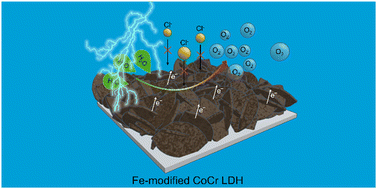
Graphical abstract: Fe-modified CoCr layered double hydroxides for boosting the seawater oxygen evolution reaction

Supplementary files

Article information

Article type
Paper
Submitted
03 Sep 2025
Accepted
28 Oct 2025
First published
05 Nov 2025
This article is Open Access
Creative Commons BY-NC license

EES Catal., 2026,4, 230-238

Fe-modified CoCr layered double hydroxides for boosting the seawater oxygen evolution reaction

E. Nasr, P. Byaruhanga, D. Wang, S. Chen, L. Yu and Z. Ren, EES Catal., 2026, 4, 230 DOI: 10.1039/D5EY00267B

This article is licensed under a Creative Commons Attribution-NonCommercial 3.0 Unported Licence. You can use material from this article in other publications, without requesting further permission from the RSC, provided that the correct acknowledgement is given and it is not used for commercial purposes.

To request permission to reproduce material from this article in a commercial publication, please go to the Copyright Clearance Center request page.

If you are an author contributing to an RSC publication, you do not need to request permission provided correct acknowledgement is given.

If you are the author of this article, you do not need to request permission to reproduce figures and diagrams provided correct acknowledgement is given. If you want to reproduce the whole article in a third-party commercial publication (excluding your thesis/dissertation for which permission is not required) please go to the Copyright Clearance Center request page.

Read more about how to correctly acknowledge RSC content.

Social activity

Spotlight

Advertisements