


 PLATFORM UPDATE:


Solvation effects in liquid-phase esterification reactions catalyzed by hydrogen-form ion exchange resins
 b
and
Thomas J.
Schwartz
*a
b
and
Thomas J.
Schwartz
*a
Abstract
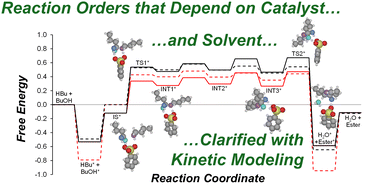
Renewable carbon resources, such as biomass or CO2, are crucial for replacing unsustainable fossil-based carbon in fuels, chemicals, and materials. However, valorization of these resources is often impeded by high oxygen content, which must be reduced, and low molecular weight, which often must be increased. Solid-acid-catalyzed reactions are critical for this valorization, and the reactions often occur in solution. The well-defined structure of crystalline solid acids, such as zeolites, makes them amenable for study, while other materials, such as the AmberlystTM family of polymeric resin catalyst, are harder to characterize. Here, we apply rigorous reaction kinetics measurements coupled with density functional theory (DFT) calculations to elucidate the influence of solvation on the esterification of butyric acid with n-butanol, used as a model reaction. We find surprising kinetic behavior, whereby the reaction is first-order with respect to both butyric acid and n-butanol when toluene is used as a nonpolar solvent, but the rate both decreases and becomes zero-order with respect to both butyric acid and n-butanol when tetrahydrofuran (THF) is used as a polar, aprotic solvent. DFT calculations reveal strong binding of THF to the sulfonate active sites on AmberlystTM, which partially explains the decrease in rate, while strong hydrogen bonding of the reactants with the solvent lead to an overall decrease in entropy in the bulk phase, thereby improving the thermodynamics for adsorption of the reactants to the catalyst and causing the observed shift in reaction order.
- This article is part of the themed collection: EES Catalysis Recent HOT articles
 Please wait while we load your content...


