


 PLATFORM UPDATE:


Integrating catchment, climate and reservoir drivers to estimate the risk of THM formation at a drinking water treatment plant inlet

Abstract
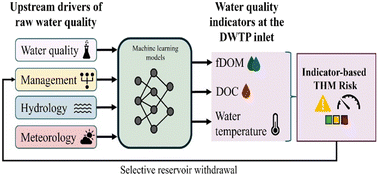
Using long-term monitoring and machine learning, this study links upstream hydrometeorology, reservoir processes, and operations to source water conditions relevant to trihalomethane (THM) formation risk at the Mediterranean Ter drinking water treatment plant (DWTP) in Spain, supplied by a three-reservoir cascade (Sau–Susqueda–Pasteral). Based on exploratory analyses, three target variables were selected as indicators of THM formation risk: dissolved organic carbon (DOC) and water temperature (WT) at the DWTP inlet, and fluorescent dissolved organic matter (fDOM) at the Susqueda withdrawal depth. Permutation importance results using Random Forest and LSTM models indicated that withdrawal-layer conditions at Susqueda dominate downstream variability: DOC was most strongly associated with extracted fDOM and other withdrawal water quality variables, whereas inlet WT was primarily controlled by Susqueda withdrawal temperature. For fDOM at Susqueda, reservoir storage volume emerged as a major driver, highlighting the influence of water availability, retention time, and stratification on DOM dynamics. Optimized LSTM models predicted the three target variables with strong validation skill (R2 and KGE > 0.8). Scenario simulations identified seasonal windows of opportunity for THM risk reduction, with selective withdrawal targeting low-fDOM or cooler layers reducing indicator-based THM formation risk at the DWTP inlet, particularly during warm stratified periods and post-summer rainfall transitions. The effectiveness of this strategy was event-dependent and constrained by reservoir levels and gate accessibility. These results highlight opportunities to reduce DBP formation risk through upstream management, supporting a shift from end-of-pipe control to multi-barrier strategies, particularly in regions facing increasing hydroclimatic stress.
- This article is part of the themed collection: Recent Open Access Articles - Environmental Science: Water Research & Technology
 Please wait while we load your content...


