


 PLATFORM UPDATE:


Mechanistic elucidation and real water application of a band-engineered CoMgAl-LTH/CdS S-scheme heterojunction as an efficient advanced oxidation process-based catalyst for textile dye degradation and environmental safety evaluation
 *a
*a
Abstract
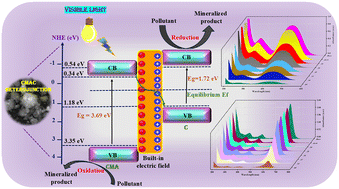
The discharge of persistent textile dyes into aquatic systems poses a major challenge for effective wastewater treatment due to their high chemical stability, toxicity and resistance to conventional remediation methods. Developing visible-light-responsive photocatalysts that achieve efficient degradation while ensuring safe mineralization remains an urgent research priority. In this work, a band-engineered CoMgAl layered triple hydroxide/CdS nanocomposite was successfully prepared through a hydrothermal treatment to fabricate a highly efficient S-scheme heterostructure photocatalyst for the degradation of textile dyes via an advanced oxidation process (AOP). The obtained samples were characterized using XRD, FTIR, SEM, HR-TEM, XPS, UV-vis DRS, PL and EIS analysis. The internal electric field (IEF) formed at the CMAC interface significantly promotes the separation of charge carriers and hinders electron–hole recombination, resulting in high visible-light absorption and a strong redox ability. Consequently, remarkably high photocatalytic degradation efficiencies of 99.5% for Auramine O (AO) and 98% for Brilliant Blue (BB) were obtained under visible-light irradiation with a low catalyst dosage and the process followed pseudo-first-order kinetics. Additionally, reactive oxygen species (ROS) have been proven to be the dominant and effective active species in wastewater treatment through scavenger experiments. LC–MS analysis was conducted to understand the degradation pathways and by-products. Toxicity evaluation using T.E.S.T. software predicted a considerable decrease in the toxicity of the intermediates obtained upon degradation. Therefore, this study reveals that the CMAC S-scheme heterojunction is an efficient, stable and environmentally safe photocatalyst, providing a promising strategy for the practical visible-light-driven removal of dyes from polluted wastewater.
 Please wait while we load your content...


