


 PLATFORM UPDATE:


Desaturation and chemical recovery from desalination concentrates using ion exchange and bipolar membrane electrodialysis as a zero liquid discharge process

Abstract
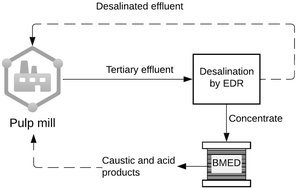
The cellulose pulp industry still consumes high amounts of water, making water recovery essential. To address this, pulsed electrodialysis reversal (pEDR) has been proposed; however, the remaining concentrate management is still a challenge. Thus, this study evaluates an integrated system combining ion exchange, pEDR and bipolar membrane electrodialysis for concentrate desaturation and simultaneous recovery of caustics and acids, as an alternative to conventional zero liquid discharge systems, such as evaporation and crystallization. Experiments with ion exchange resins assessed their capacity with industrial effluents, while bipolar membrane electrodialysis was tested at different voltages and (synthetic) reject stream concentrations. A nine-step setup simulated industrial performance, achieving 0.67 M NaOH with 73% efficiency and an energy consumption of 4.57 kWh kg−1 NaOH. Economic analysis showed that integrating pEDR with evaporation and crystallization in an industrial scale system requires nearly 38% more in capital cost than integrating pEDR with the desaturation system. The operational cost for evaporation–crystallization with pEDR is 0.43 USD per m3, while desaturation with pEDR costs 0.34 USD per m3 and decreases to 0.20 USD per m3 with soda valorization. These results show a more sustainable and cost-effective alternative for zero liquid discharge in the cellulose pulp industry.
- This article is part of the themed collection: Recent Open Access Articles - Environmental Science: Water Research & Technology
 Please wait while we load your content...


