


 PLATFORM UPDATE:


Molecular-scale investigation of Cu(ii) interactions with synthetic and natural zeolites during removal and recovery

Abstract
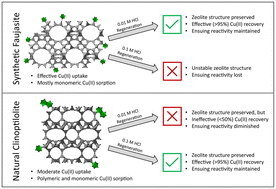
Copper (Cu) is simultaneously an environmental pollutant present in industrially relevant waters, including geothermal fluids, and a strategic raw material (SRM) in the European Union, which highlights the value of technologies that couple its removal and recovery. In this work, we investigated the uptake and subsequent recovery of Cu(II) using two zeolites with distinct structures: synthetic faujasite and natural clinoptilolite. Batch Cu(II) adsorption isotherms (0.001 to >1 mM Cu(II)), kinetic Cu(II) uptake measurements, and acidic zeolite regeneration experiments were combined with molecular-scale solid-phase characterization by synchrotron-based X-ray diffraction and Cu K-edge X-ray absorption spectroscopy. Our results revealed significant differences in Cu(II) uptake, extractability and solid-phase speciation depending on zeolite structure. With respect to Cu(II) uptake, synthetic faujasite outperformed natural clinoptilolite, removing more Cu(II) per zeolite mass with faster uptake kinetics. The characterization data indicated synthetic faujasite removed Cu(II) primarily via monomeric adsorption (i.e., outer- and inner-sphere complexes), whereas Cu-loaded natural clinoptilolite contained a mixture of monomeric and polymeric Cu (i.e., Cu–Cu bonding was detected). Multiple acidic regeneration cycles of synthetic faujasite was highly effective (>95% Cu(II) extracted) using 0.01 M HCl, with higher HCl concentrations destabilizing the faujasite structure. By contrast, 0.1 M HCl was required to extract Cu(II) efficiently from natural clinoptilolite, with minimal impact on zeolite structure. Taken together, these macroscopic and molecular-scale results provide critical information to optimize the deployment of zeolite-based filters for holistic Cu(II) removal and recovery from aqueous solution.
 Please wait while we load your content...


