


 PLATFORM UPDATE:


Bayesian network analysis infers the importance of post-construction support in maintaining the functionality of pit latrines and septic systems across 12 countries
 *a
and
Ryan
Cronk
a
*a
and
Ryan
Cronk
a
Abstract
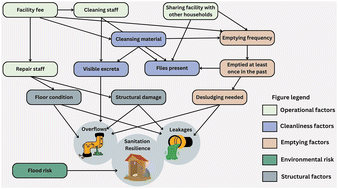
Pit latrines and septic systems are widely used in low-income countries across sub-Saharan Africa. Despite their critical role in providing basic sanitation, these systems face challenges in maintaining functionality due to issues such as overflowing and leakage, posing significant public health risks. This study examined operations and maintenance (O&M) factors affecting the functionality of on-site sanitation systems, focusing on overflow and leakage patterns, and explored strategies to enhance system performance. Data from 18 534 sanitation facilities across 12 countries, comprising 94% pit latrines and 6% septic systems were analyzed. Using a Bayesian Belief Network analysis, the analysis identified factors influencing system functionality, including desludging frequency, structural damage, and flood risk. Among the systems analyzed, 28% showed evidence of overflowing (29% pit latrines, 17% septic systems), and 24% showed evidence of leakage (24% pit latrines, 14% septic systems). Including flood risk in the model increased overflow rates by 1% and leakage rates by 4% in high-risk flood-prone areas. System performance was primarily influenced by desludging frequency, floor and structural integrity, and the availability of maintenance personnel. Simulations indicated that uniformly implementing frequent desludging across the network had the greatest influence, reducing overflow rates by 72% and leakage rates by 17% relative to current conditions. These findings suggest that post-construction support, such as regular desludging and access to qualified repair personnel, could substantially improve system reliability, particularly in high-risk flood-prone areas, and should be prioritized in sanitation policy and infrastructure design.
- This article is part of the themed collection: Recent Open Access Articles - Environmental Science: Water Research & Technology
 Please wait while we load your content...


