


 PLATFORM UPDATE:


Assessment of the long-term user experience of tiger worm toilets using the Sanitation-Related Quality of Life (SanQoL) index

Abstract
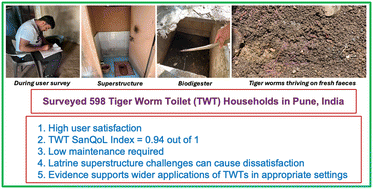
Tiger worm toilets (TWT) are a relatively new on-site sanitation technology compared to other sanitation types (e.g. pit latrines), with some of the oldest TWTs globally now having been in continual use for only approximately 10 years. TWTs use composting worms to degrade human waste, thereby reducing fill rate and odour, and making latrine emptying safer. However, there is a significant gap in understanding the long-term user experience and maintenance requirements of TWTs. To explore this, 358 users were surveyed, and 380 TWTs were visually inspected in Pune, India. The survey employed the previously established Sanitation-Related Quality of Life (SanQoL) index to quantify TWT users' experiences. The SanQoL index showed a score of 0.94 out of 1 for TWTs, indicating a positive user experience. Additionally, 83% of users reported no need for biodigester emptying for the past decade, confirming the low-maintenance needs of TWTs. In parallel, the World Health Organization (WHO)-designed Sanitation Safety Plan was used to visually inspect and evaluate the construction quality of TWTs, revealing that poor latrine superstructure construction is a key challenge in Pune. Overall, this study, the largest such TWT survey to date, provides a substantial body of evidence needed to boost confidence in the technology and to support its expansion in other suitable settings globally.
- This article is part of the themed collections: HOT articles from Environmental Science: Water Research & Technology, Transformation and innovation for resilient equitable Water, Sanitation and Hygiene (WASH) services and Recent Open Access Articles - Environmental Science: Water Research & Technology
 Please wait while we load your content...


