


 PLATFORM UPDATE:


Additional effect of the coagulation process on removal of tetracycline from characteristically simulated livestock and poultry wastewater
 †a
Han
Zhang
*a
†a
Han
Zhang
*a
Abstract
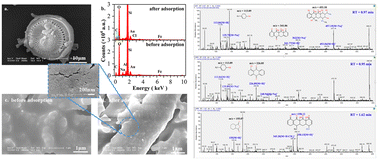
Livestock and poultry wastewater is one of the main sources of antibiotic pollution, but compared with the high concentration of COD, turbidity and other pollution indicators, the changes of trace pollutant antibiotics are often ignored in the treatment of livestock and poultry wastewater. There are few studies on the removal efficiency of antibiotics and whether there is a change in substance structure during coagulation and precipitation as a commonly used livestock and poultry wastewater treatment process. The optimal removal conditions of tetracycline (TC) by flocculants FeCl3, AlCl3 and PAC were obtained by simulating the turbidity of actual livestock and poultry wastewater and providing a flocculant formation environment. Comparative analysis showed that FeCl3 coagulant had the best adsorption efficiency for TC. The flocs formed by FeCl3 coagulant adsorbed tetracycline to form dense particles, and the flocs of AlCl3 and PAC coagulant formed a stacked network after adsorption. It is worth noting that the optimal efficiency may be caused by the change of reaction environment which is caused by the concentration ratio of coagulant aid (NaHCO3) and coagulant, and TC is degraded by chemical reactions. In addition, not only adsorption in the process of removal of tetracycline by coagulation and precipitation, but also the morphological structure of tetracycline was changed which may be due to the oxidation of high-valence metal ions or the presence of hydroxyl metal ions and Cl−. This study found that in the traditional coagulation process with the main goal of removing turbidity and organic matter, the unexpected synergistic removal efficiency of trace antibiotic tetracycline is of great value. It can achieve the ‘multiple’ pollution control effect without changing the core process of the existing water treatment plant, which provides a scientific basis for reducing the environmental emission of antibiotics at low cost.
- This article is part of the themed collection: HOT articles from Environmental Science: Water Research & Technology
 Please wait while we load your content...


