


 PLATFORM UPDATE:


Surface characteristics of electrodes in microbial electrolysis cells: a review on wastewater treatment
 a
and
Vinka
Oyanedel-Craver
*a
a
and
Vinka
Oyanedel-Craver
*a
Abstract
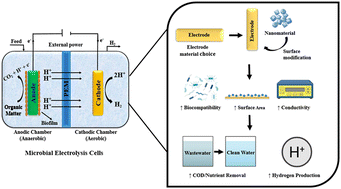
Microbial electrolysis cells (MECs) are emerging as promising technologies for coupling wastewater treatment with renewable hydrogen production, but their efficiency hinges on electrode design. This review synthesizes 41 studies covering 55 electrode combinations, revealing how electrode composition and surface characteristics shape performance. Carbon-based anodes such as graphite felt and carbon cloth achieved chemical oxygen demand (COD) removal up to 95% and hydrogen production rates (HPR) between 0.1 and 45 m3 of H2 per m3 of reactor per day. Metal-based cathodes, particularly stainless steel (SS304), yielded HPR values of up to 314 ± 17 m3 of H2 per m3 of reactor per day with COD removal of 79 ± 4%. Modified electrodes incorporating nanoparticles and polymers further enhanced outcomes: Ni–Co–P coatings increased HPR nearly fivefold over bare metals, polymer-modified carbon felts doubled hydrogen yields and raised COD removal from 25% to >55%, and Cu/Ni nanocomposites achieved current densities of 226 A m−2 with COD removal above 75%. These results demonstrate that modified electrodes can rival platinum-based benchmarks at fabrication costs reduced by up to 50%. Despite these advances, significant challenges remain. Most studies employ simple substrates such as acetate, leaving performance under real wastewater conditions poorly understood. Key operational factors, including electrode spacing, microbial community engineering, and suppression of hydrogen-consuming pathways, are inconsistently addressed, and the long-term durability of non-noble metal cathodes under corrosive conditions is inadequately characterized. Looking forward, polymer–nanocomposite hybrids and three-dimensional electrode architectures represent promising innovations, combining high conductivity, biocompatibility, and surface area at lower cost. These strategies have already achieved COD removal above 80% and hydrogen yields approaching platinum controls, highlighting their potential to drive MECs toward scalable, cost-effective deployment in sustainable wastewater treatment and renewable energy production.
- This article is part of the themed collections: Environmental Science: Water Research & Technology Recent Review Articles and Recent Open Access Articles - Environmental Science: Water Research & Technology
 Please wait while we load your content...


