


 PLATFORM UPDATE:


Charting the future of wastewater-based epidemiology for vector-borne diseases: opportunities, challenges, and climate-driven needs
 a
Alessandro
Zulli,
b
Farah
Ishtiaq,
c
Judith Chui Ching
Wong,
d
Juliana Calabria
de Araujo,
e
Alexandria B.
Boehm,
b
Kyle
Bibby
a
and
Jeseth
Delgado Vela
*h
a
Alessandro
Zulli,
b
Farah
Ishtiaq,
c
Judith Chui Ching
Wong,
d
Juliana Calabria
de Araujo,
e
Alexandria B.
Boehm,
b
Kyle
Bibby
a
and
Jeseth
Delgado Vela
*h
Abstract
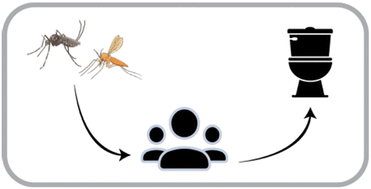
Vector-borne diseases (VBDs) pose a growing public health threat globally, driven by climate change, urbanization, and increasing human mobility. Wastewater-based epidemiology (WBE), which has proven valuable for monitoring enteric and respiratory pathogens, is now being explored as a complementary tool for VBD surveillance. This manuscript synthesizes insights from a 2025 National Science Foundation Research Coordination Network (RCN) workshop (Award # 2202361), which convened researchers and public health professionals on March 13, 2025, to assess the feasibility, challenges, and future directions of WBE for VBD surveillance. The application of WBE to VBDs has several technical and biological challenges, including low and inconsistent shedding of arboviruses in feces and urine, RNA degradation in wastewater, availability of sewered networks for identification of hotspots, geography, and the limited performance of clinical qPCR assays in complex environmental matrices. Newer methods such as metagenomic sequencing and digital PCR (dPCR) offer enhanced sensitivity and detection, but are resource intensive and require additional technical specialization. The strategic selection of sentinel sampling locations such as hospitals, airports, and congregate settings can improve early detection, particularly in non-endemic or travel-associated outbreak contexts. The geographical expansion of competent arboviral vectors have been exacerbated by climate change, urging the development of WBE systems that are adaptable, geographically targeted, and integrated with climate and socio-ecological data. We highlight the need for interdisciplinary collaboration, methodological innovation, and public health engagement to translate WBE signals of vector borne pathogens into timely and actionable responses. As global disease landscapes continue to evolve, WBE may serve as an important early warning system for emerging and re-emerging VBD threats.
 Please wait while we load your content...


