


 PLATFORM UPDATE:


Granular activated carbon for bromacil removal: experimental and predictive techniques

Abstract
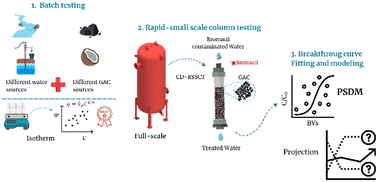
Bromacil, a broad-spectrum herbicide classified as a probable carcinogen, poses significant health and environmental risks due to its persistence and mobility in groundwater. This study investigates the removal of bromacil from spring and groundwater using commercial bituminous- and coconut-based granular activated carbons (GACs). Batch adsorption experiments with samples from three contaminated sites in Costa Rica (C0 = 0.10–1.30 μg L−1) revealed that bituminous GAC exhibited higher adsorption capacities (kF = 0.55–0.89 (μg mg−1)(L μg−1)1/n; 1/n = 0.30–0.42) compared to coconut GAC (kF = 0.30–0.40 (μg mg−1)(L μg−1)1/n; 1/n = 0.30–0.42), likely due to its broader mesoporous structure. Constant diffusivity rapid small-scale column tests (CD-RSSCTs) with bituminous GAC were conducted to simulate full-scale performance for small community water systems (<1000 m3 per day) at EBCTs of 5.7 and 8.2 minutes. The results indicated that full-scale adsorbers could treat approximately 66 000 and 141 000 bed volumes (corresponding to 277 and 805 days of operation) before reaching the bromacil maximum contaminant level (MCL) of 0.1 μg L−1. Furthermore, pore-surface diffusion model (PSDM) simulations predicted operational lifespans ranging from 3.4 to 84 months for inlet bromacil concentrations of 20 to 1 μg L−1, respectively, under an EBCT of 15 minutes. These findings highlight the potential of GAC as an effective and safe strategy for bromacil removal from drinking water sources. However, differences in the adsorption capacities of B-GAC and C-GAC should be interpreted cautiously, considering the specific NOM concentration and composition of each water matrix.
 Please wait while we load your content...


