


 PLATFORM UPDATE:

Comprehensive review of PFAS occurrence, regulatory frameworks, analytical, and remediation methodologies: emphasis on the Arabian Gulf and arid regions

Abstract
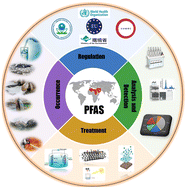
Per- and polyfluoroalkyl substances (PFAS) constitute a diverse class of highly stable synthetic organofluorines increasingly recognized for their environmental persistence, bioaccumulative behavior, and toxicological significance. It is especially concerning that they are frequently found in environmental matrices such as soil, groundwater, surface water, and biota globally. The impact is expected to be more severe in regions such as the Middle East and North Africa (MENA), where climatic conditions and water scarcity amplify the impact of even trace-level contamination. Groundwater, a critical resource in these regions, is especially vulnerable to PFAS infiltration from industrial effluents, landfill leachates, and aqueous film-forming foams (AFFFs). These unique pressures underscore the urgent need for a comprehensive assessment of PFAS in water systems across the Arabian Gulf and other arid regions. The review highlights several key insights. While PFAS have been detected in water systems across the region, available monitoring studies are limited compared to other parts of the world. In addition, regulatory frameworks for PFAS remain nonexistent, while international regulatory agencies such as the U.S. EPA and ECHA have established frameworks for legacy PFAS like PFOA and PFOS. On the analytical side, sample collection, preparation, and preservation are critical challenges due to the broad spectrum of PFAS chemistries and complex matrices. In addition, established analytical methods such as LC–MS/MS face barriers related to infrastructure cost and technical expertise. Concerning treatment technologies, conventional treatment methods have proven largely ineffective, with advanced methods like ion exchange resins and other sorption techniques leading the current research and large-scale treatment landscape. Overall, a regionally tailored, multidisciplinary approach is imperative to mitigate PFAS risks. Given the region's high per capita industrial footprint, extreme climatic conditions, and water insecurity, a significant pollution burden is anticipated, and extensive monitoring campaigns are recommended.
- This article is part of the themed collections: Environmental Science: Water Research & Technology Recent Review Articles, Environmental Science for a Healthier Planet and Recent Open Access Articles - Environmental Science: Water Research & Technology
 Please wait while we load your content...


