


 PLATFORM UPDATE:

Biotransformation and partitioning of structurally different PFAS by wastewater microbial consortia

Abstract
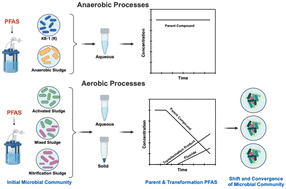
Water resource recovery facilities (WRRFs) are sinks of legacy and replacement per- and polyfluoroalkyl substances (PFAS). This study evaluates the potential biotransformation, bioaccumulation, and adsorption of PFAS in wastewater sludge. Individual partitioning of parent PFAS and transformation products were measured in aqueous and solid phases of aerobic and anaerobic bacterial cultures for five structurally variable legacy and replacement PFAS using independent tests: perfluorooctanoic acid (PFOA), perfluorooctane sulfonic acid (PFOS), perfluorobutane sulfonic acid (PFBS), 6:2 fluorotelomer sulfonate (6:2 FTS), and hexafluoropropylene oxide dimer acid (GenX). Anaerobic cultures (anaerobic digestate and dehalogenating KB-1®) showed only adsorption (10.9–38.3%) with no transformation of the parent PFAS, irrespective of structural variances, in 90 days. Aerobic cultures from activated and nitrification sludge resulted in adsorption (26.9 ± 1.2–55.8 ± 1.4%), biotic accumulation (13.35–17.55%), and transformation (28.96–47.87%) of long-chain PFAS in 21 days. Notably, PFOA, PFOS, and 6:2 FTS were rapidly transformed 47.87 ± 1.6%, 28.96 ± 0.6%, and 43.1 ± 1.0%, respectively, after a shift occurred in microbial community structure under batch growth after 6 days, with the generation of shorter-chain compounds (carboxylates and sulfonates) and limited defluorination. Aerobic wastewater microbial communities converged, with Methylophilus, Acidomonas, Pseudomonas, Clostridium, Klebsiella, and Acinetobacter positively correlated with PFAS degradation. This study highlights the importance of unit processes and microbial community structure in controlling the fate and transport of select PFAS.
- This article is part of the themed collection: Recent Open Access Articles - Environmental Science: Water Research & Technology
 Please wait while we load your content...


